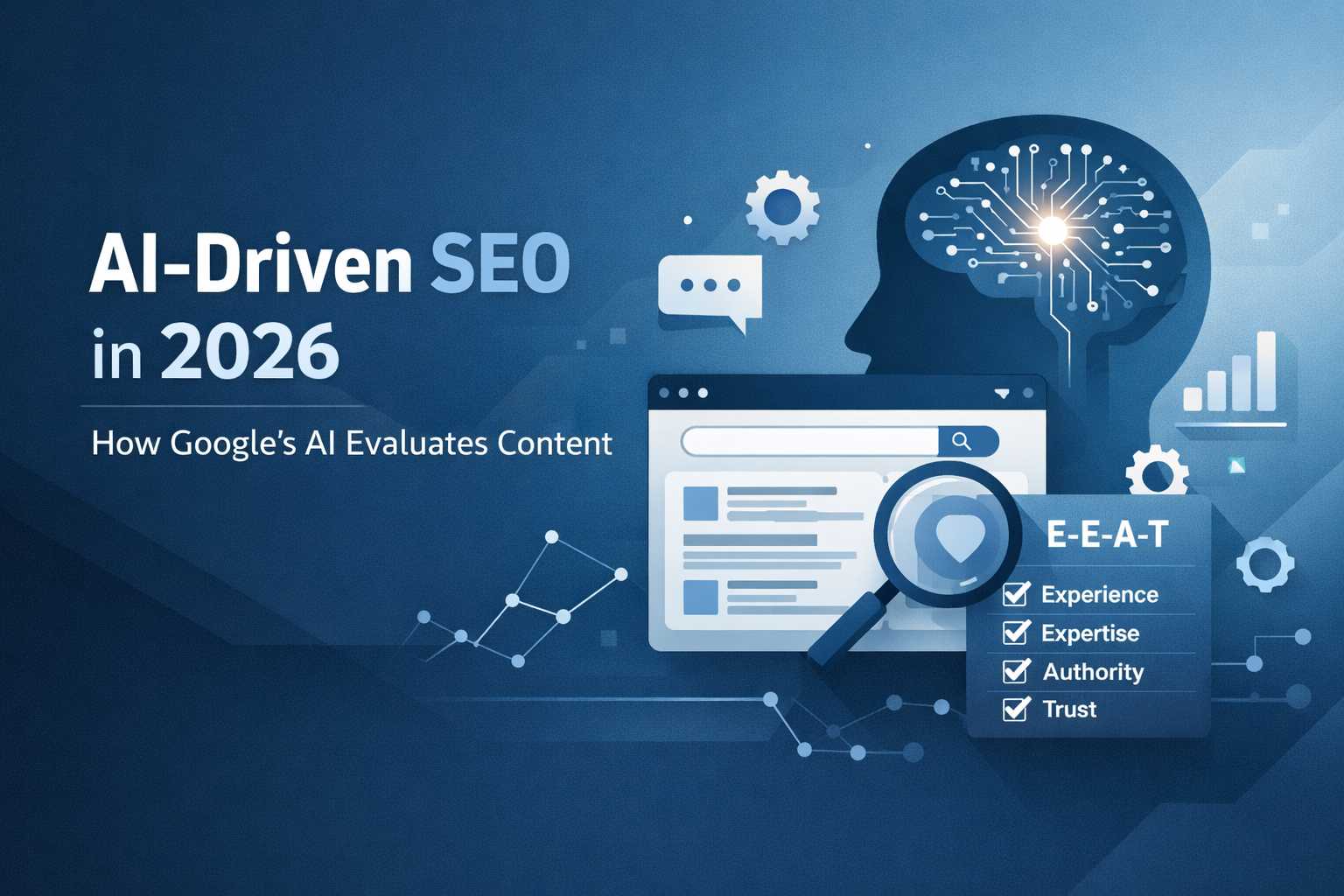
AI-Driven SEO in 2026: How Google’s AI Algorithms Evaluate Content
Search Engine Optimization has entered a new era. In 2026, ranking on Google is no longer driven by keywords, backlinks, or technical optimizations alone. Instead, search visibility is shaped by how Google’s Artificial Intelligence understands, evaluates, and trusts content.
As AI systems become more sophisticated, SEO has evolved into a discipline that blends technology, user psychology, content intelligence, and real-world expertise. This shift is what we now call AI-Driven SEO.
This article explains how Google’s AI algorithms evaluate content in 2026 and what businesses must do to stay competitive in organic search.
What Is AI-Driven SEO?
Table of Contents
AI-Driven SEO refers to optimizing websites specifically for machine-learning-powered search systems rather than traditional rule-based algorithms.
In 2026, Google uses advanced AI models to:
- Interpret search intent instead of matching exact keywords
- Understand content context and semantic meaning
- Measure experience, expertise, authority, and trust
- Analyze real user behavior signals
- Generate AI-powered answers directly in search results
SEO today is less about manipulating algorithms and more about aligning content with how AI understands value.
How Google’s AI Algorithms Evaluate Content in 2026
1. Search Intent Is the Primary Ranking Factor
Google’s AI starts by identifying why a user is searching.
Search queries are evaluated as:
- Informational
- Commercial
- Transactional
- Comparative
- Problem-solving
If your content does not fully satisfy the dominant intent, it will struggle to rank—regardless of keyword optimization.
Key takeaway: SEO success depends on solving the entire user problem, not just answering part of it.
2. Contextual and Semantic Understanding
Google’s AI evaluates content holistically, not sentence by sentence.
It understands:
- Topic relationships
- Supporting subtopics
- Semantic relevance
- Natural language patterns
This is why topical authority is essential in 2026. Content must demonstrate comprehensive subject knowledge rather than isolated keyword targeting.
Thin or incomplete pages are filtered out by AI.
3. EEAT Is Enforced by Algorithms
Experience, Expertise, Authority, and Trust (EEAT) are now measurable ranking signals.
Google’s AI evaluates:
- First-hand experience indicators
- Author and brand credibility
- Accuracy and consistency of information
- Online reputation and brand mentions
Websites that lack trust signals may appear informative but will fail to achieve sustainable rankings.
4. Human Value Over Content Creation Method
Google does not penalize AI-generated content—but it does penalize low-value content, regardless of who or what created it.
AI systems can detect:
- Generic or repetitive language
- Over-optimized phrasing
- Lack of originality
- Content written solely for ranking
High-performing content in 2026 delivers:
- Unique insights
- Practical value
- Real-world experience
- Clear, human-focused explanations
5. User Engagement Signals Matter More Than Ever
Google’s AI analyzes how users interact with your content after clicking.
Important signals include:
- Click-through rate (CTR)
- Time spent on page
- Scroll depth
- Engagement actions
- Return visits
Poor engagement signals indicate low satisfaction and can reduce rankings—even for technically optimized pages.
6. AI Overviews and Answer-Based Search Results
AI-generated answers now dominate many search results.
To appear in these AI overviews, content must:
- Answer questions clearly and concisely
- Use logical headings and structure
- Demonstrate expertise and trust
- Address follow-up questions naturally
This evolution has given rise to Answer Engine Optimization (AEO), where content is written to be understood and reused by AI systems.
How to Optimize for AI-Driven SEO in 2026
- Focus on topics, not individual keywords
- Create deep, comprehensive content
- Add human experience and insight
- Improve content structure and readability
- Strengthen brand and author trust signals
- Optimize page experience and usability
Common SEO Mistakes in the AI Era
- Writing content only for search engines
- Publishing AI content without human refinement
- Ignoring user experience and engagement
- Over-optimizing language unnaturally
- Producing thin or repetitive content
- Chasing algorithm updates instead of intent
FAQs: AI-Driven SEO in 2026
What is AI-Driven SEO?
AI-Driven SEO is the practice of optimizing content for AI-powered search algorithms that focus on intent, context, user experience, and trust rather than just keywords and links.
Does Google penalize AI-generated content in 2026?
No. Google does not penalize AI-generated content. However, it penalizes low-quality, unhelpful, or misleading content, regardless of how it is created.
How does Google’s AI evaluate content quality?
Google’s AI evaluates content based on intent satisfaction, topical depth, EEAT signals, originality, user engagement, and overall usefulness.
Are keywords still important in AI-Driven SEO?
Yes, but keywords are secondary. Google’s AI prioritizes semantic meaning and topic relevance over exact keyword usage.
What is Answer Engine Optimization (AEO)?
AEO is the practice of optimizing content to appear in AI-generated answers, featured snippets, and zero-click results by providing clear, authoritative, and structured responses.
How can small businesses compete with AI-driven search?
By focusing on niche expertise, authentic experience, high-quality content, strong branding, and excellent user experience rather than volume-based content production.
Will backlinks still matter in 2026?
Backlinks still matter, but they work as trust signals, not standalone ranking boosters. Quality, relevance, and brand authority matter more than link quantity.
Final Thoughts
AI-Driven SEO is not a passing trend—it is the future of search.
In 2026, ranking success belongs to brands that:
- Understand user intent deeply
- Demonstrate real expertise
- Build trust consistently
- Deliver genuine value
SEO today is about earning visibility, not forcing it.