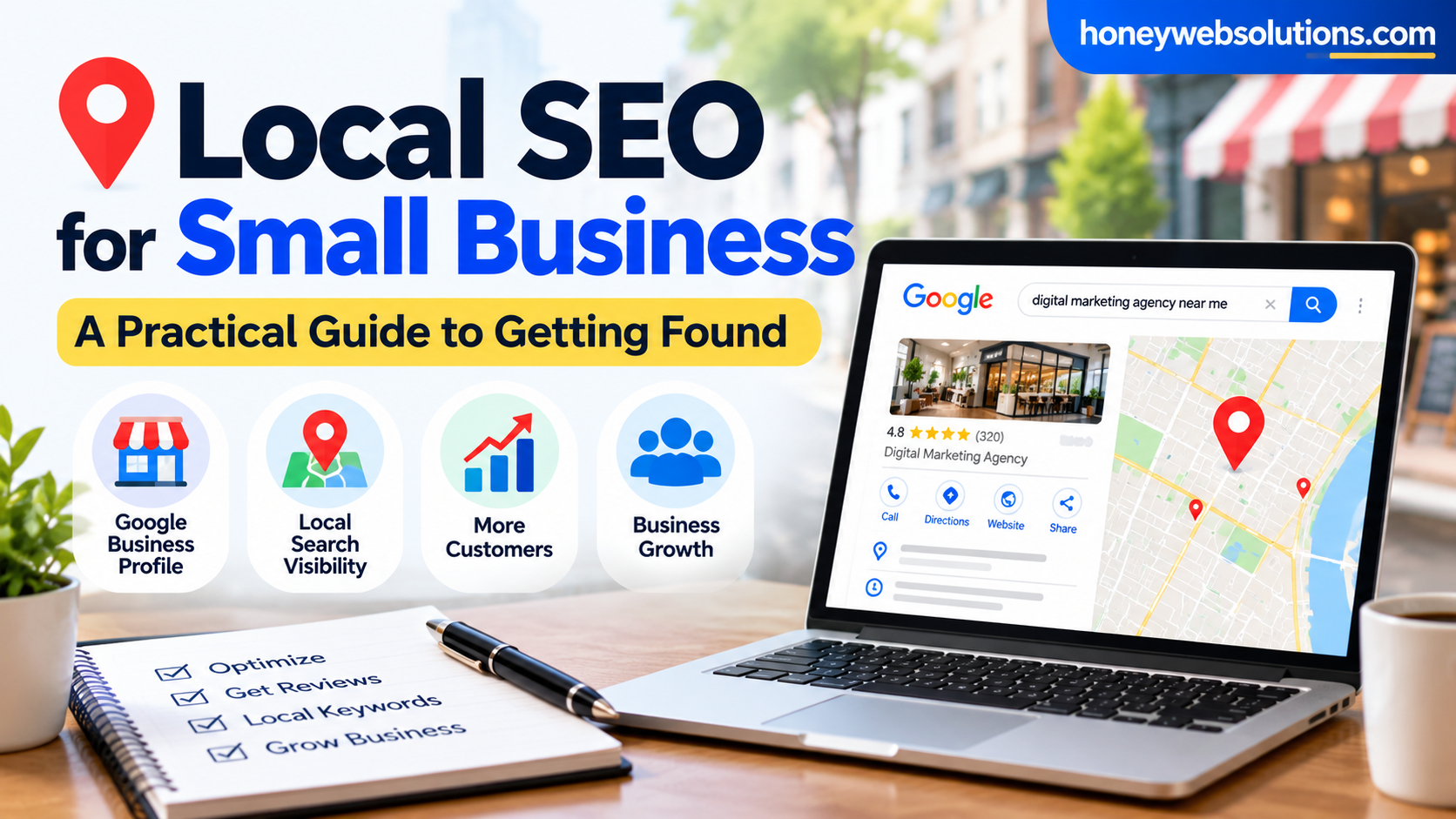
Local SEO for Small Business: A Practical Guide to Getting Found
A small business can have an excellent product and a professional website and still struggle to attract customers online.
One reason is simple: potential customers need to find the business before they can contact it.
That is where local SEO becomes important.
Local SEO helps businesses appear when people search for products, services or companies in a particular location. For a small business serving a city, town or specific service area, local search visibility can be more valuable than competing for broad national keywords.
What Is Local SEO?
Table of Contents
Local SEO is the process of improving a business’s online presence so it can appear for searches connected with a particular location.
Examples include:
- Web designers near me
- Plumbers in Tirupati
- Digital marketing agency in Hyderabad
- Best restaurants in Chennai
- Computer repair near me
The searcher is not simply looking for information. In many cases, they are looking for a business they can contact or visit.
Why Local SEO Matters
Large companies often have substantial resources for SEO.
A local business can compete differently.
Instead of trying to rank nationally for a huge keyword such as “digital marketing,” a company can target more specific searches such as “digital marketing agency in [city].”
These searches may have a smaller audience, but they can have much stronger commercial intent.
1. Create and Optimise Your Business Profile
A business’s local profile should contain accurate information.
Make sure the business name, address, phone number, website, business hours and categories are correct.
Use the same business information consistently across important online properties.
2. Build a Location-Focused Website
Your website should clearly explain:
- What you offer
- Who you serve
- Where you operate
- How customers can contact you
Create useful location pages only when they represent genuine services or service areas.
Do not create dozens of nearly identical pages simply by changing city names.
3. Publish Local Content
Local content can help demonstrate relevance.
For example, a web-development company could publish:
“How Small Businesses in Tirupati Can Improve Their Websites”
A home-service company could publish:
“Common Plumbing Problems in Older Homes”
The topic should provide genuine information rather than simply inserting a city name repeatedly.
4. Collect Genuine Reviews
Customer reviews can influence how potential customers perceive a local business.
Ask genuine customers for honest reviews after completing a service.
Never create fake reviews.
It is also useful to respond professionally to reviews, including negative ones.
5. Earn Local Links
Local links can strengthen a website’s visibility.
Potential sources include:
- Local business associations
- Community organisations
- Local publications
- Industry directories
- Business partners
- Relevant events
The goal should be relevance and credibility rather than collecting hundreds of low-quality directory links.
6. Optimise for Mobile Users
Many local searches happen on smartphones.
A visitor should be able to quickly:
- Call the business
- Find the address
- Open directions
- View services
- Submit an enquiry
A slow or difficult mobile website can lose potential customers even when the business appears in search.
7. Track the Right Metrics
Traffic alone doesn’t tell the entire story.
Monitor:
- Local search visibility
- Website visitors
- Phone calls
- Contact-form enquiries
- Direction requests
- Conversion rate
- Search queries
The objective is not simply to attract visitors. It is to attract people who could actually become customers.
Common Local SEO Mistakes
Avoid:
- Keyword stuffing
- Fake reviews
- Duplicate location pages
- Incorrect business information
- Buying low-quality links
- Ignoring mobile users
- Publishing thin local articles
Final Thoughts
Local SEO is not about tricking search engines.
It is about making it easier for search engines and potential customers to understand what a business does, where it operates and why it may be relevant.
For a small business, a focused local SEO strategy can be more practical than trying to compete for enormous national keywords.
Trending