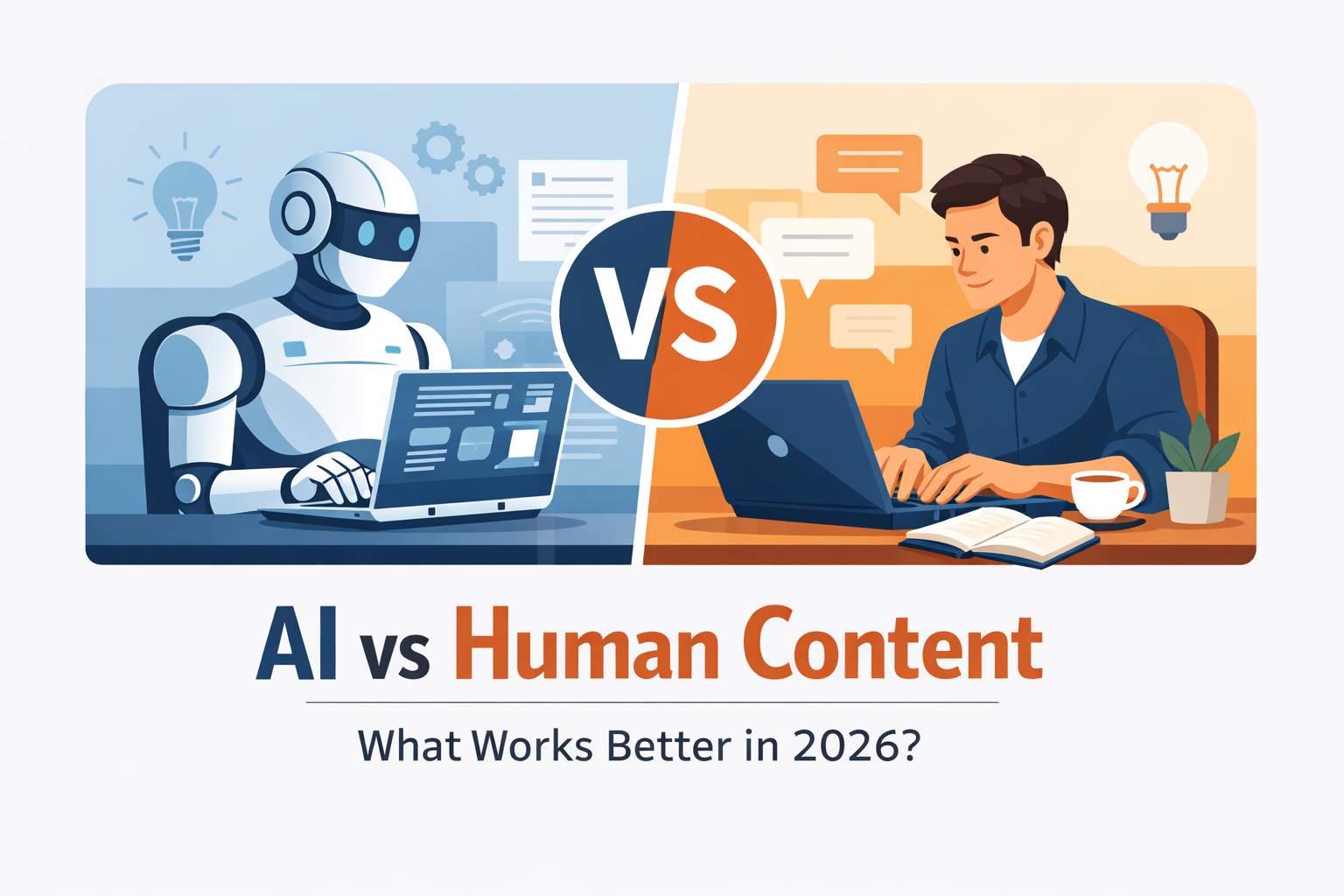
AI vs Human Content: What Works Better in 2026?
Content marketing in 2026 is defined by one major debate: AI-generated content vs human-written content. With AI tools producing articles, emails, and web pages in minutes, businesses are questioning whether human writers are still necessary—or if AI can fully take over.
The truth is more nuanced. AI has transformed content production, but performance, trust, and long-term SEO success still depend heavily on human intelligence. This guide explores what truly works better in 2026 and how brands should approach content creation moving forward.
Understanding AI-Generated Content in 2026
Table of Contents
AI-generated content is created using advanced language models trained on vast amounts of online data. In 2026, AI can quickly produce blog posts, optimize content for keywords, suggest headings, generate FAQs, and even align content with search intent.
Where AI Content Excels
AI performs exceptionally well when speed and scale matter. It is highly effective for:
- SEO-focused informational blogs
- Product descriptions and category pages
- FAQ sections and knowledge bases
- Content outlines and topic research
- Repurposing content across platforms
AI brings efficiency, consistency, and cost-effectiveness, making it a valuable tool for modern marketing teams.
However, AI-generated content often lacks original thought, emotional depth, and real-world experience, which limits its effectiveness in trust-driven scenarios.
Understanding Human-Written Content in 2026
Human content is driven by experience, creativity, empathy, and strategic thinking. Unlike AI, human writers can form opinions, share lived experiences, and adapt content to emotional and cultural contexts.
Strengths of Human Content
Human-written content excels in:
- Storytelling and persuasion
- Thought leadership and opinion pieces
- Brand voice development
- Complex B2B and decision-stage content
- Trust-sensitive topics such as finance, health, and legal information
Human content builds credibility, authority, and emotional connection, which remain essential ranking and conversion factors in 2026.
AI vs Human Content: Key Differences
| Aspect | AI Content | Human Content |
| Speed | Very fast | Slower but intentional |
| Cost | Lower | Higher |
| Creativity | Pattern-based | Original thinking |
| SEO Support | Strong | Strategic |
| Trust & Credibility | Moderate | High |
| Conversions | Medium | High |
| E-E-A-T Signals | Limited | Strong |
AI wins in efficiency, while humans win in trust and impact.
What Works Better for Google in 2026?
Google in 2026 does not penalize AI content simply for being AI-generated. Instead, it evaluates content based on:
- Usefulness and originality
- Demonstrated experience
- Accuracy and depth
- Trustworthiness
AI content can rank well if it is properly edited, enhanced, and validated by humans. However, mass-produced, generic AI content without human refinement is increasingly filtered out by Google’s quality systems.
The Winning Strategy: Hybrid Content Creation
The most successful brands in 2026 do not choose between AI and humans—they combine both.
How a Hybrid Strategy Works
- AI assists with research, structure, and SEO optimization
- Human writers add insights, experience, and originality
- Editors ensure accuracy, tone, and trust signals
- SEO specialists align content with user intent
This approach delivers scalable content without sacrificing quality, making it the most effective long-term strategy.
Final Verdict
- AI content works best for scale and efficiency
- Human content works best for trust and conversions
- Hybrid content works best for sustainable SEO success
AI is a powerful assistant, but human expertise remains irreplaceable in 2026.
FAQs: AI vs Human Content in 2026
Is AI-generated content good for SEO in 2026?
Yes, when edited and enhanced by humans. Raw, unedited AI content often lacks depth and originality, which limits ranking potential.
Can Google detect AI-written content?
Google focuses on quality rather than detection. Low-value or repetitive content is devalued regardless of whether it is written by AI or humans.
Which converts better: AI content or human content?
Human-written content typically converts better due to emotional connection, persuasion, and trust-building.
Is AI content considered plagiarism?
AI content is not automatically plagiarism, but it must be edited and originality-checked to avoid similarity with existing content.
Will AI replace content writers?
AI will not replace skilled writers. It will replace those who do not adapt to strategy, SEO, and value-driven writing.
What content should not be fully AI-generated?
Health, finance, legal, and expert opinion content should always involve human expertise and accountability.
Is a hybrid content strategy better?
Yes. Combining AI efficiency with human intelligence delivers the best SEO, engagement, and long-term results.
Does AI content affect E-E-A-T?
AI alone cannot demonstrate experience. Human input is essential to strengthen E-E-A-T signals.